
Piece of Cake 1.1 — A Snapdeck-Native Fine-Tuned Model Built on Gemma 4
On June 20, 2026, Snapdeck is introducing Piece of Cake, a model family for presentation generation and editing. The default profile is Piece of Cake 1.1; the quality-first profile is Piece of Cake 1.0 Pro.
Presentations are not merely visual outputs. They are decision artifacts. Government proposals, research talks, investor decks, and business plans all carry format constraints and review criteria. In this category, AI has to do more than produce an attractive draft. It has to preserve evidence, respect the required format, and reduce the cost of revision.
Piece of Cake 1.1 is a Snapdeck-native model fine-tuned from the Gemma 4 31B and 12B families and adapted to Snapdeck's generation harness. In the internal evaluation harness, 1.1 reached an 82% level of output quality, with an average generation time of 71 seconds for a 10-slide deck. Piece of Cake 1.0 Pro is a more conservative quality profile and reached an 86% level under the same internal measurement framework.
These figures are not official SlideTailor scores, nor are they copied from public Gemma 4 benchmarks. They are Snapdeck internal product metrics. This article is not a universal leaderboard claim. It is a record of the research frame we used, the product constraints we considered, and the level of validation we can report.
Business Problem Framing
The research baseline for this work is SlideTailor: Personalized Presentation Slide Generation for Scientific Papers, an AAAI 2026 paper. The paper frames slide generation as preference-guided paper-to-slides generation, not as ordinary summarization.
That framing matters commercially. The bottleneck in presentation work is not only the time spent creating the first slide. A large share of the cost appears later: adapting the draft to an institutional template, checking evidence, responding to stakeholder feedback, and preserving editability. For an AI slide product to become a work tool rather than a demo, it has to reduce that downstream cost.
A presentation is not a shortened document. The same paper or report can require different emphasis depending on the audience, institutional template, talk duration, evaluation criteria, and visual conventions. A capable slide model must decide what to foreground, which evidence to preserve, how dense each slide should be, and how much of the existing .pptx structure should remain intact.
SlideTailor estimates those preferences from a paper-slide example pair and a PPTX template. The setting is close to Snapdeck's actual product use. Users bring government grant templates, investor decks, research papers, company layouts, and existing PPTX files; after generation, they continue editing with AI and direct manipulation.
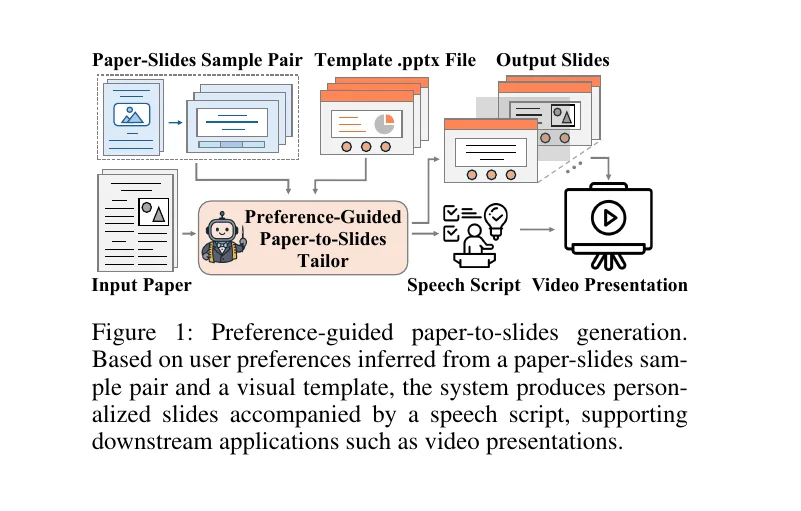
Source: Zeng et al., "SlideTailor: Personalized Presentation Slide Generation for Scientific Papers", arXiv:2512.20292. The arXiv record links to CC BY-SA 4.0. Excerpted from Figure 1.
The difficulty lies in three coupled requirements.
- Source alignment: the model must compress without inventing unsupported claims.
- Visual constraints: templates, layout, colors, tables, and image placement need to be respected or deliberately reconstructed.
- Editability: the result must remain usable as a PPTX-aware object, not a flattened image.
Piece of Cake is Snapdeck's fine-tuned model family for this class of task. Research-wise, it is a preference-aware generation problem. Business-wise, it is a productivity problem: reducing the cost of both the first draft and the revisions that follow.
Research-Informed Thresholds
SlideTailor introduces the PSP (Paper-to-Slides with Preferences) dataset. The public dataset description includes target research papers, slide templates, curated paper-slide pairs, and evaluation configurations. In Table 1, the paper summarizes PSP as containing 200 test papers, 500 preference types, and 100,000 combinations.
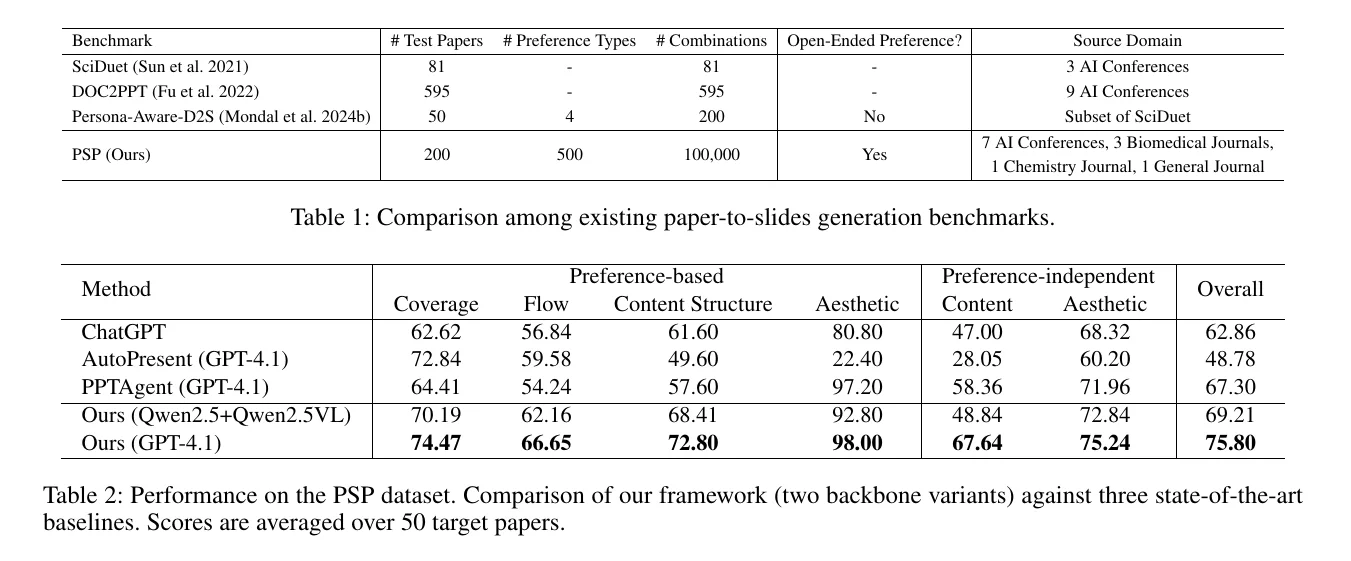
Source: Zeng et al., SlideTailor, arXiv:2512.20292. Excerpted from Tables 1 and 2.
In automatic evaluation, the strongest reported overall average is 75.80% for the SlideTailor GPT-4.1 variant. The Qwen2.5/Qwen2.5VL-based variant is reported at 69.21%. The paper notes that no method exceeds an overall average of 80%.
At the same time, the Appendix reports an 81.63% win rate for SlideTailor against PPTAgent in a human preference comparison.
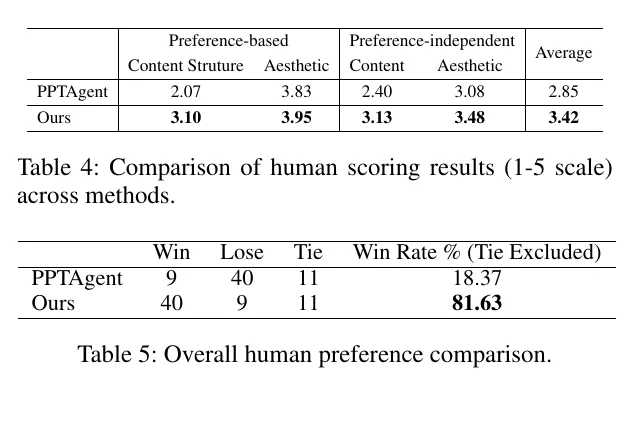
Source: Zeng et al., SlideTailor, arXiv:2512.20292. Excerpted from Tables 4 and 5.
These results are not contradictory. Automatic evaluation shows that the 80% region is difficult to reach, while human preference suggests that template and preference awareness can materially improve perceived quality. Snapdeck used this observation as a product decision guide: the low-80% range is a meaningful threshold where preference-aware slide generation begins to look usable for serious work.
Foundation and Productization
Gemma 4 provides a strong foundation for this work. Google's Hugging Face model card reports Gemma 4 31B results including 85.2% MMLU Pro, 89.2% AIME 2026 no tools, 80.0% LiveCodeBench v6, and 84.3% GPQA Diamond. The same table reports Gemma 4 12B Unified at 77.2% MMLU Pro, 77.5% AIME 2026, and 72.0% LiveCodeBench v6.
Google's developer guide describes Gemma 4 12B as a unified, encoder-free multimodal model. That is relevant because slide work is not pure text generation. It combines document structure, visual hierarchy, image context, numbers, tables, and template constraints. Snapdeck therefore evaluated the 31B family for heavier structural reasoning and the 12B family for faster interactive workflows.
The main contribution in Piece of Cake is not merely the choice of foundation model. It is the adaptation of the model to Snapdeck's product path: uploading documents, importing PPTX, preserving templates, revising individual slides, and exporting editable results. The fine-tuning target is workflow continuity. In product terms, model quality is measured not only by standalone benchmark performance, but by how quickly the user receives an editable result they can trust enough to continue.
At a publishable level, the development principles are as follows.
| Principle | Product meaning | Measurement view |
|---|---|---|
| Preserve input context | Keep PDFs, text, PPTX files, and attachments in the same work context | Source-to-slide message alignment |
| Infer preference signals | Use examples, templates, and prior decks as generation conditions | Content preference and aesthetic preference alignment |
| Prioritize presentation flow | Plan the argument before optimizing individual slide text | Coverage, flow, content structure |
| Maintain PPTX editability | Leave generated output editable for the next user action | Element-level editability and Magic Edit success |
| Control the time budget | Improve quality while keeping 10-slide timing usable | Average generation time for 10 slides |
This is not a disclosure of internal implementation. It is the evaluation contract behind the product harness. Researchers need measurable axes; operators need repeatable outputs. Piece of Cake is designed to bring those two requirements into the same workflow.
Product Profiles
Piece of Cake 1.1 is Snapdeck's default presentation model. In the internal harness, it reached an 82% level with an average 10-slide generation time of 71 seconds. The evaluation focused on a repeatable operating point across varied inputs and templates, not on a single best-case sample.
1.1 is optimized for four product requirements.
- Segment source material into slide-level messages
- Preserve the tone and structure of existing PPTX/templates
- Keep generated slides available for AI-assisted revision
- Place 10-slide generation time inside a usable product range
Piece of Cake 1.0 Pro is the quality-first profile. It reached an 86% level in the internal harness and is intended for tasks where evidence preservation and format stability matter more than speed: government grant decks, institutional proposals, investor presentations, paper talks, and PPTX-based rewriting.
The profiles are not simply ordered by version number. 1.1 is the balanced default; 1.0 Pro is the more conservative setting for high-cost documents. From a product standpoint, the user can decide whether the task calls for faster iteration or stricter review.
What Made It Difficult
The difficulty of presentation generation is not a single speed-quality trade-off. Higher quality tends to increase inference time; faster generation can weaken structural decisions. Stronger template preservation may make content placement rigid, while aggressive content restructuring can damage the original format.
SlideTailor's Figure 2 illustrates this procedural nature: content preference and aesthetic preference must be handled together.
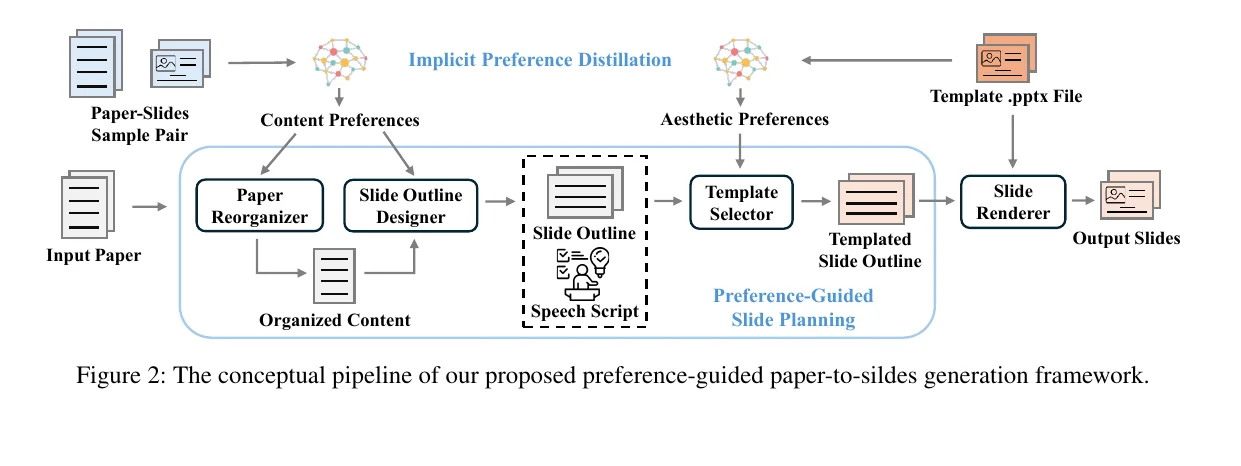
Source: Zeng et al., SlideTailor, arXiv:2512.20292. Excerpted from Figure 2.
Snapdeck adds product constraints on top of that research setting: PPTX import/export, slide-level editing, Magic Edit, template reuse, and file-attached generation. The model must not only produce slides; it must leave behind an editable structure for the next user action. This is also the business-critical part of the problem. Users do not always need a perfect final deck immediately; they often need a first version they can review, correct, and move forward with. The 82% level and 71 seconds should be read as the first stable operating point under those combined constraints.
Recommended Business Use Cases
Use Piece of Cake 1.1 for fast first drafts and iterative editing. The intended loop is to upload material, generate an approximately 10-slide deck, inspect the output, and revise weak slides with Magic Edit.
Use Piece of Cake 1.0 Pro when format and evidence are more important than speed. Government grants and R&D programs are good examples because the evaluation items are usually fixed in advance. If the required template and section structure are provided first, the model can separate market need, technical approach, team capability, and commercialization plan more reliably.
For research presentations, upload the paper and a reference deck together when possible. As SlideTailor suggests, example slides are not merely visual references; they encode how a presenter compresses and arranges the underlying material.
For investor decks and internal reports, define the key numbers before generation. Revenue, retention, customers, pipeline, and research results give the model stable anchors and reduce unnecessary rewriting. Business material needs both persuasion and auditability; the stronger the inputs, the easier it is to review the generated deck.
Market Benchmark: 10-Slide Average
The unit of comparison is average generation time for a 10-slide deck. Time is measured from input start to completion of a 10-slide presentation. The speed comparison is reorganized around Design Arena's Slides benchmark and public 10-slide timing observations. Because public sources and internal measurements do not share a single protocol, the comparison should be read as market research rather than a controlled ranking. Even so, this observation matters for product strategy: users will not wait for quality alone, and they will not trust speed alone.
The quality frame combines the paper's core evaluation dimensions with the measurement axes used in Snapdeck's internal harness.
| Evaluation item | Unit | Weight | Method | Reference point |
|---|---|---|---|---|
| Content alignment | % | 40% | TrueSource-style factual/source alignment and SlideTailor-PSP content alignment | World-best level 67.64%, Korean baseline 65.92% |
| Visual attractiveness | % | 40% | Layout, balance, readability, color consistency, visual reconstruction | World-best level 75.24%, Korean baseline 74.17% |
| Slide generation time | seconds | 20% | Average time from input start to completed 10-slide deck | Design Arena basis: Gamma 63s; Snapdeck direct measurement: MiriCanvas/Miridi in the 81s range |
The performance chart matters more than the speed chart in this section. SlideTailor evaluates preference-aware generation through coverage, flow, content structure, aesthetic alignment, general content quality, general aesthetic quality, and overall quality. The chart below reconstructs values read from the paper tables and result images, then places Snapdeck's internal measurements on the same problem axis. The Piece of Cake values should not be read as official SlideTailor benchmark scores; they are internal measurements under Snapdeck's product harness.
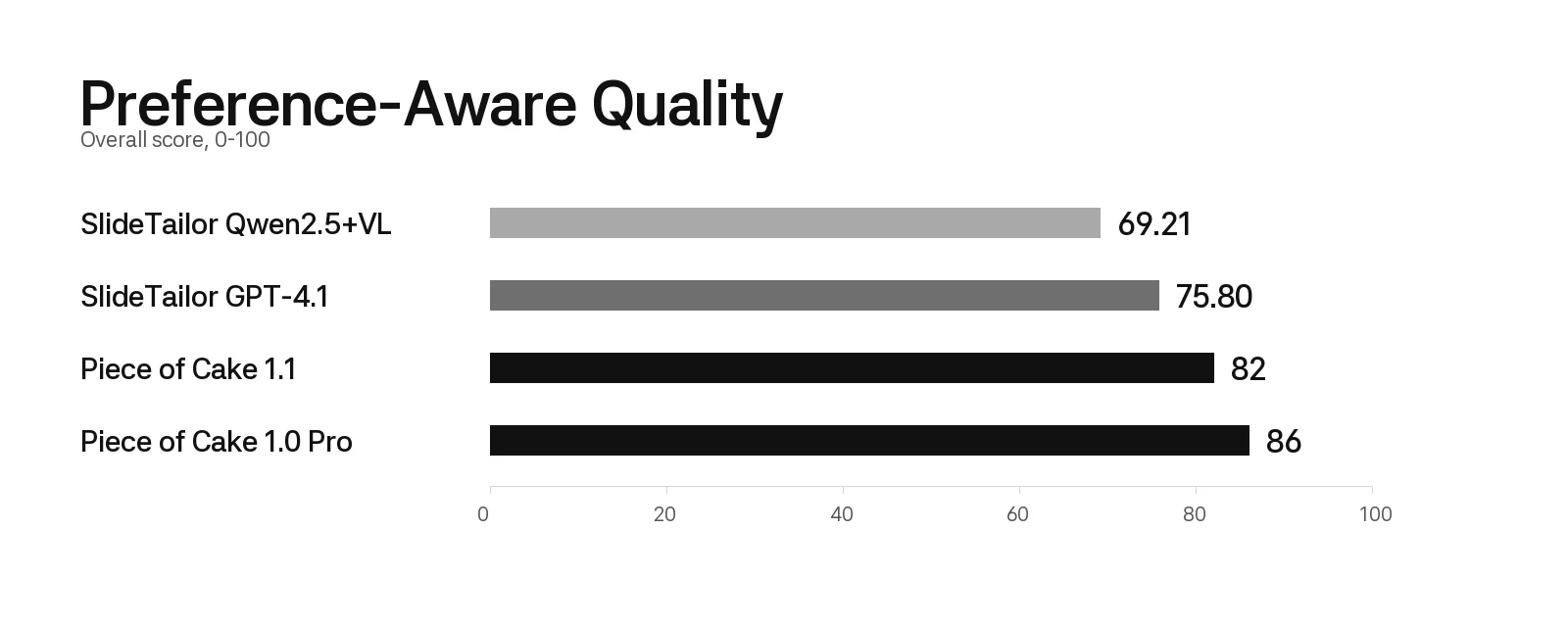
Paper-aligned performance measurement. SlideTailor values are reconstructed from Table 2, human evaluation, and ablation result images in the paper. Piece of Cake 1.1 and 1.0 Pro are Snapdeck internal harness measurements. These are not identical public benchmark scores; they are shown together as a research note on preference-aware slide generation.
Under this frame, Piece of Cake 1.1 reached an 82% level with 71-second average generation for 10 slides. Piece of Cake 1.0 Pro reached an 86% level in the quality-first profile. Since comparable content/visual scores are not publicly disclosed for the commercial tools below, the speed chart is presented separately as a secondary indicator.
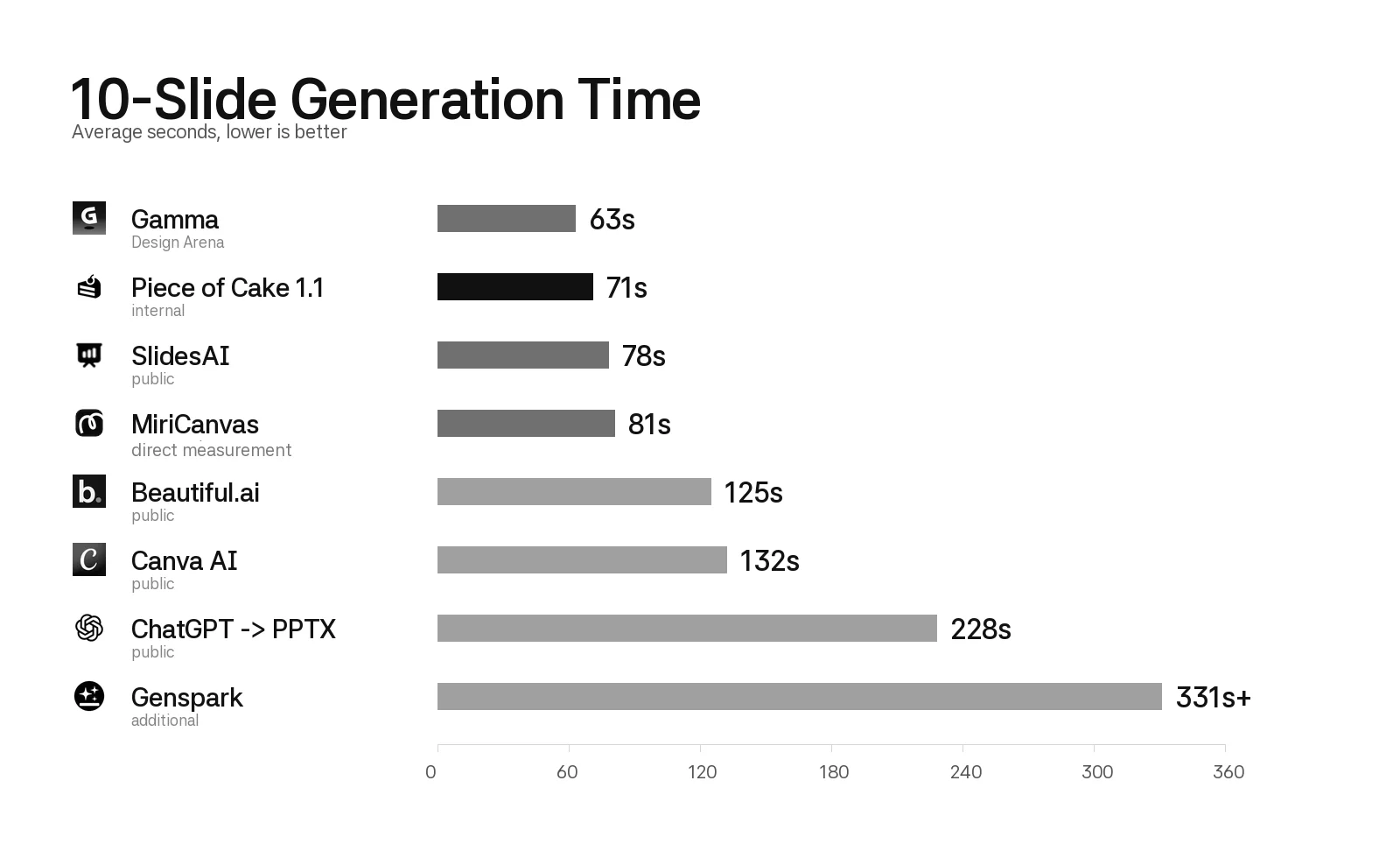
Average 10-slide deck generation time. Gamma at 63s follows the Design Arena basis; MiriCanvas/Miridi in the 81s range is Snapdeck's direct measurement average under the same comparison condition. Piece of Cake timing is an internal average. SlidesAI, Beautiful.ai, Canva AI, and ChatGPT values refer to a public 10-slide speed benchmark. Genspark is shown at 331s+ from an additional 10-slide benchmark basis.
| Product | Average 10-slide generation time | Basis | Interpretation |
|---|---|---|---|
| Gamma | 63s | Design Arena Slides benchmark | Presented as the world-best 10-slide timing reference |
| Piece of Cake 1.1 | 71s | Snapdeck internal harness | Default profile observed together with the 82% quality level |
| SlidesAI | 78s | Public 10-slide speed benchmark | Fast Google Slides/PowerPoint-oriented generation |
| MiriCanvas | 81s range | Snapdeck direct measurement | Direct Korean/Miridi comparison measured across repeated generations |
| Beautiful.ai | 125s | Public 10-slide speed benchmark | Design automation and team workflow focus |
| Canva AI | 132s | Public 10-slide speed benchmark | Strong editing assets and design ecosystem |
| ChatGPT -> PPTX | 228s | Public 10-slide speed benchmark | Closer to a conversion workflow than a dedicated slide generator |
| Genspark | 331s+ | Additional 10-slide benchmark basis | Research-to-deck workflow, but longer timing in this comparison |
| Microsoft Copilot, Presentations.AI, Plus AI, Pitch, Adobe Express, Decktopus | N/A | No reviewed public average under the same 10-slide condition | No estimate is added where comparable timing is unavailable |
Competitor positioning is also clear at the feature level. Canva emphasizes Magic Design for Presentations and broad editing assets. Gamma provides a wide content surface across presentations, documents, and websites, with PPT/PDF export. MiriCanvas explicitly supports AI outline generation, PPTX download, and element-level editing in PowerPoint. Beautiful.ai focuses on PowerPoint import/export and team workflows. Plus AI and SlidesAI operate strongly inside Google Slides and PowerPoint. Microsoft Copilot generates and revises presentations from prompts or files within PowerPoint.
Snapdeck's position is therefore not a pure speed claim. Piece of Cake is optimized for 10-slide timing, source alignment, visual quality, PPTX context, and downstream AI editability at the same time. The 71-second timing can still improve, but it is a meaningful operating point when evaluated with quality and editability together. In market terms, the goal is not the fastest demo; it is repeatable output that survives actual work.
What These Numbers Mean
These numbers should be read in three layers.
First, SlideTailor reports a strongest automatic overall score of 75.80% on PSP and an 81.63% human preference win rate against PPTAgent. This is the research reference point for what the problem space has achieved so far.
Second, Gemma 4 public materials indicate a strong foundation for reasoning, coding, multimodal, and long-context tasks. This is the model foundation Piece of Cake starts from.
Third, Piece of Cake 1.1 at 82%, Piece of Cake 1.0 Pro at 86%, and the 71-second 1.1 timing are Snapdeck internal product metrics. They are not direct equivalents of public research scores or official competitor quality scores; they are operating measurements observed inside Snapdeck's product environment.
This distinction is how Snapdeck makes the claim precise. On top of the research problem defined by SlideTailor, we report the quality and speed measured in our own product harness. What matters is not louder language, but repeatable output and time returned to users.
Piece of Cake does not treat presentation work as trivial. It turns a complex sequence of material interpretation, format control, evidence preservation, and follow-up editing into a more continuous product flow. Snapdeck's goal is to keep users from solving structure, design, evidence, and editability as separate problems on a blank canvas. Model reasoning, preference-aware generation, and PPTX editing are brought into one product path.
Piece of Cake 1.1 is the first public result of that work: a model that reads the material, carries forward the format, preserves evidence, and produces a deck that can be revised again. Snapdeck treats slides not as static files generated once, but as work objects that can continue to be understood, revised, and improved. In that sense, Piece of Cake changes the starting point of presentation work.
Public References
- SlideTailor arXiv record
- SlideTailor HTML full text
- SlideTailor official GitHub repository
- SlideTailor PSP dataset on Hugging Face
- Google Gemma 4 model card on Hugging Face
- Gemma 4 12B Developer Guide
- Design Arena Slides leaderboard
- Design Arena methodology
- Public 10-slide speed benchmark
- MiriCanvas AI Presentation Maker
- Canva AI Presentation Maker
- Gamma
- Beautiful.ai
- Plus AI
- SlidesAI
- Presentations.AI
- Decktopus
- Pitch
- Microsoft PowerPoint AI generator
- Adobe Express AI presentation generator
- Genspark AI presentation maker